Share to slack

This blog has no CMS. Every post is a file in our website's code, and I publish it the way our product team ships any change: in Spring, as a pull request that engineering merges.
Why not a CMS
We built this blog with an outside team of freelancers, so our own team could stay focused on the product. When I told our freelance developer we were planning a blog, he asked which CMS I wanted underneath it.
I smiled and said: "I don't need a CMS. I'll do it all in Spring."
I know WordPress well. At the design agency where I used to work, that's how we ran content on the sites we designed. But Spring gives me access to everything on our website. I can change any page myself and send it to engineering as a pull request, so a blog is just more pages. Posts live in the website's code, next to the pages they link to, and they go through the same review as every other change to the site.
How it came together
- October 20: we decided what the blog is for. We wanted a place to talk to product people honestly about what we're seeing, in an industry that's changing at a pace none of us has seen before. It's also a stage for everyone at Spring to share how they see things from where they sit, whether that's a behavioral insight, a technical detail or a philosophical position.
- A starting point in Spring: I built a first version of the post page in Spring and gave it to our designers, so they had the real structure to start from.
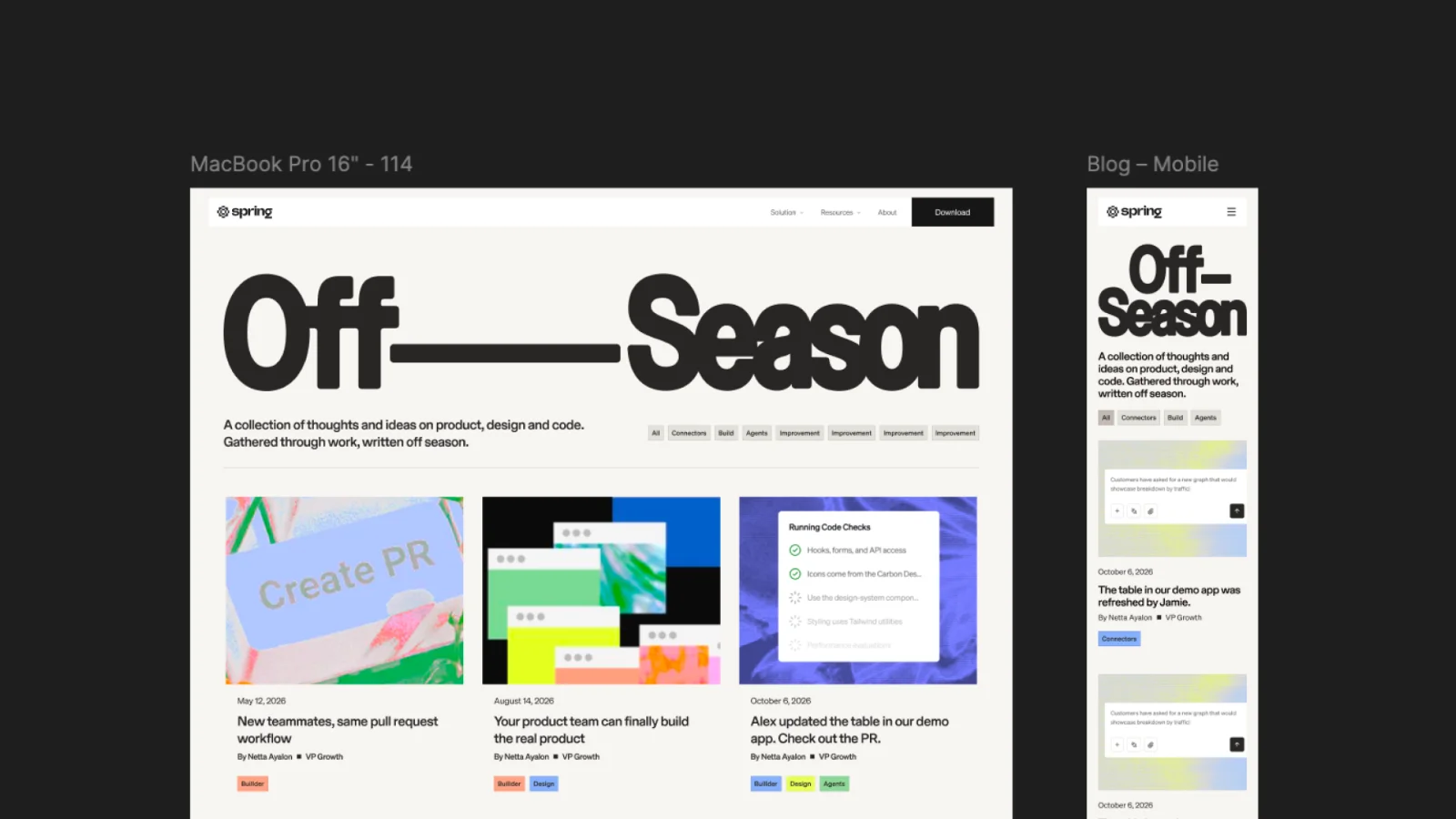
- The design: the designers we work with designed the template in Figma and named it Off-Season. We went to Figma on purpose: our marketing site doesn't have a design system yet, and its visual language is still taking shape.
- November 8: our freelance developer built the approved design into the website in one pull request: 31 files, merged the next morning.
- November 17: I published the first real post, in Spring. Once the design was approved, everything went back to Spring.
Who does what
Three roles, and none of them waits on the others for a new post:
- Our designers designed how the blog looks.
- Our freelance developer built the template once. Now he and I both send pull requests to the same repository. His pull requests change the code, and mine add posts. Each one is reviewed before it's merged.
- Someone on our team writes a post, and I publish it. A new post is one file, plus its images.
What publishing a post looks like
I keep one Spring session on our website's repository for all the blog posts. Whenever there's a new post to publish, I go back to that session and ask Spring to add a new page. I get the text from whoever wrote the post, and hand all of it to Spring in one prompt. I can paste the text, upload a Markdown file, pull in a doc through a connector, or bring an artifact made in another AI tool. Spring puts each part where it belongs on the page and suggests where to add images. I see the post on the real site in Spring's preview, exactly as readers will, including on smaller screens and mobile devices.
When it's ready, Spring opens a pull request. Engineering merges it, and the post is live. If something in the post's details is wrong, like a tag that doesn't exist, the build fails with a message that says which file and what's wrong, before anything reaches readers.
Not only for product teams
Spring is built for product people: product managers and designers. Working on this blog showed that marketing has a place there too, and it made the work our teams do together simpler. When you can share a session with colleagues, pass the same idea back and forth on one canvas, and end up with real code that's ready for review, the picture changes.